

How a scan called Nociscan reads the chemistry of your discs, what the research shows so far, and what it still can’t tell us.
Picture someone who has had low back pain for two years. They’ve done physical therapy. They’ve tried injections. Finally, they get an MRI, and the report reads like a list of suspects: a bulge at L3-4, degeneration at L4-5, a tear at L5-S1.
Three levels. Three possible culprits. And one question that sounds simple but is surprisingly hard to answer: which disc is actually causing the pain?
That question is one I think about with patients every week, because the answer shapes everything that comes next. Today I want to tell you about a tool that is trying to help answer it. It’s called Nociscan, and I’m proud to be the first surgeon in Georgia to offer it to my patients. I also want to be straight with you about what it can do, what it can’t, and what the science still has to prove.
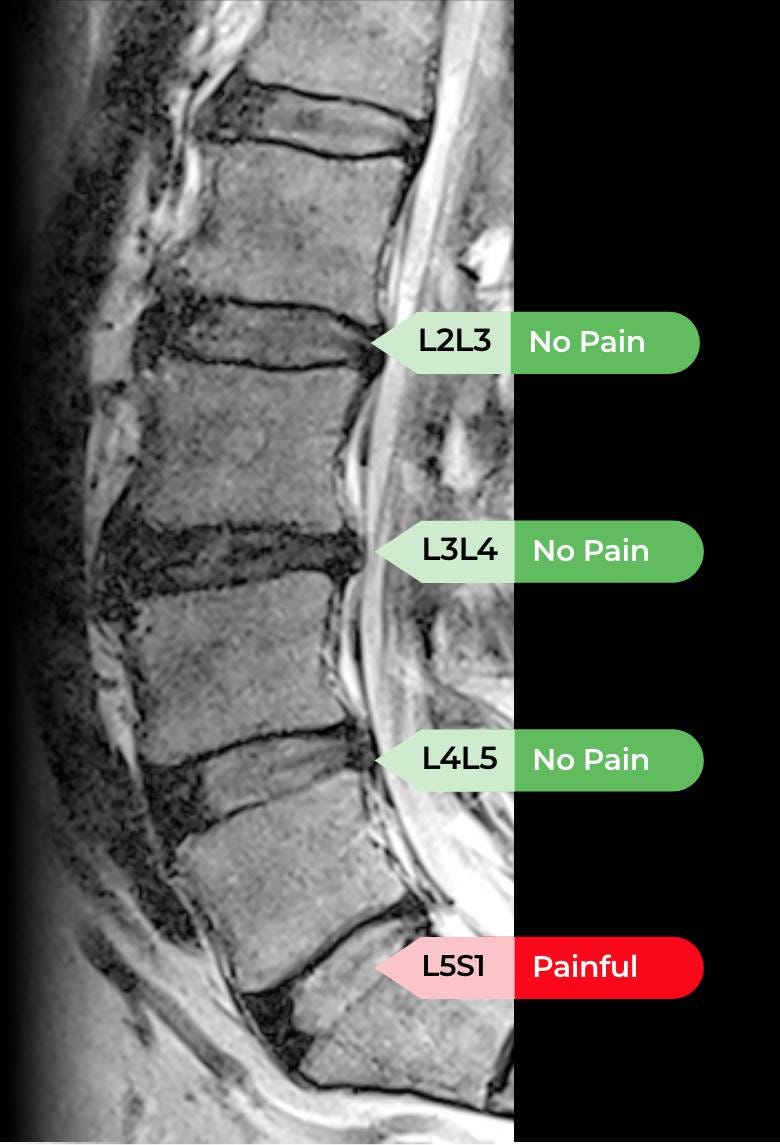
Why an MRI Can’t Always Answer the Question
An MRI is a wonderful picture of your anatomy. It shows the shape of a disc, how hydrated it is, whether it’s bulging, whether a nerve is being squeezed. What it can’t do is tell us whether a particular disc is *painful*.
Here’s why that is important. A large systematic review pooled data from 33 studies and more than 3,000 people who had no back pain at all. Disc degeneration showed up on imaging in 37% of the 20-year-olds and 96% of the 80-year-olds. Disc bulges were found in 30% of the 20-year-olds and 84% of the 80-year-olds [1]. The authors concluded that many of these findings are likely part of normal aging and unrelated to pain [1].
In other words, a disc can look worn out and feel perfectly fine. And when someone has several worn-out discs on the MRI, picking out the one that’s actually generating the pain is a real challenge.
Doctors call pain that originates in the disc itself *discogenic* pain (dis-koh-JEN-ik, meaning “born in the disc”). It typically shows up as a deep ache in the low back, often worse with sitting or bending, and it can be stubborn. If you’re thinking about a procedure or surgery for it, knowing *which* levels are involved is one of the most important pieces of the puzzle.
Think about what’s at stake. Treat too few levels, and the real source of pain may be left behind. Treat too many, and you may be operating on discs that were never the problem. Neither is a result any patient or surgeon wants, which is why a more reliable way to tell the discs apart is such an appealing goal.
