

Think about how your health care has actually worked. Your pediatrician saw you as a kid. Your OB-GYN handled your periods and your pregnancies. Your primary care doctor checks your blood pressure once a year. And if you ever see a cardiologist, they may never hear about the preeclampsia you had with your second baby.
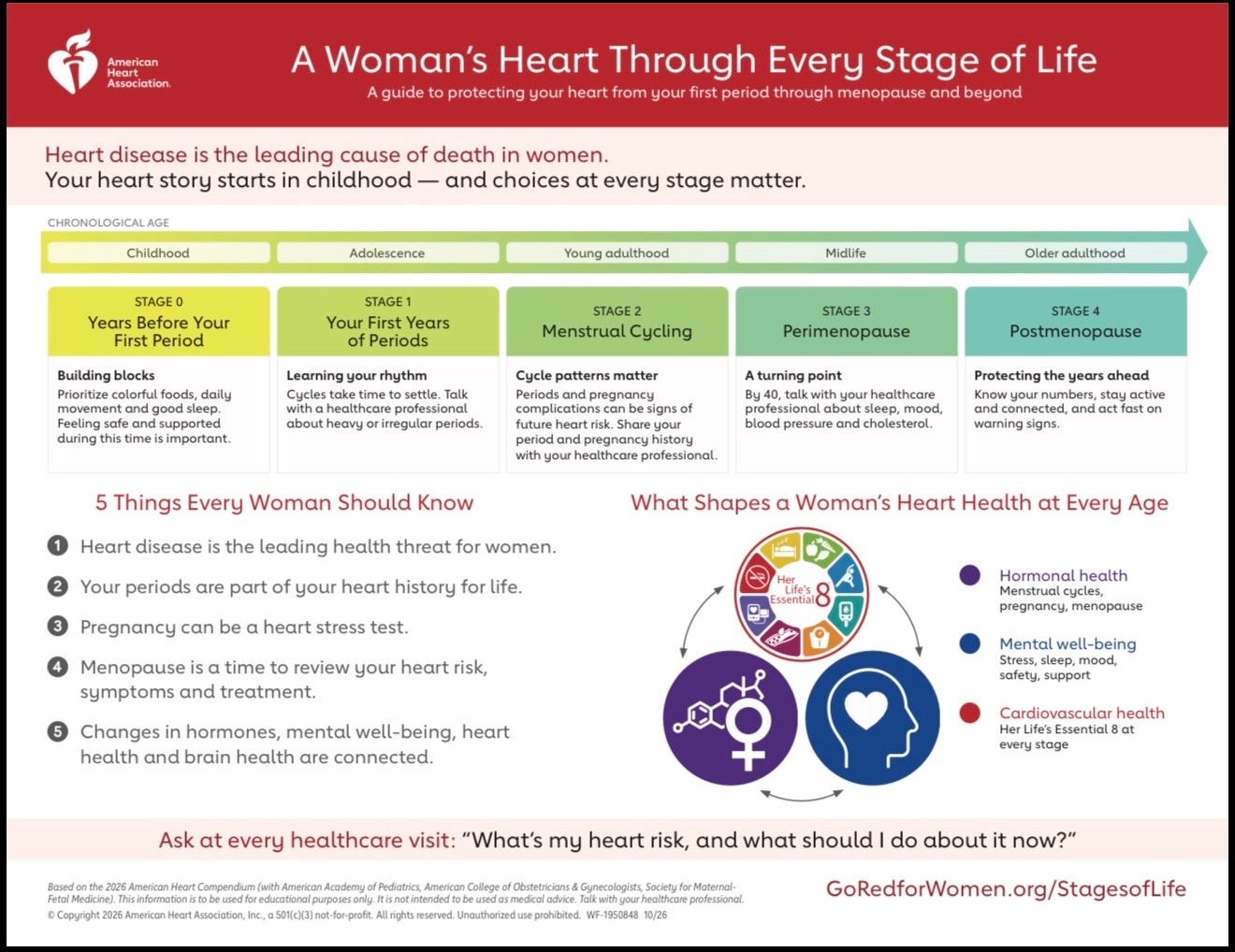
This week, four major medical groups said that has to change. The American Heart Association, the American Academy of Pediatrics, the American College of Obstetricians and Gynecologists, and the Society for Maternal-Fetal Medicine released joint guidance that, for the first time, ties a woman’s heart health to the stages of her life, starting around her first period [1]. As a woman and as a physician, I think this is one of the most important things to come out of women’s health in years. Here’s what it means for you.
New here? Subscribe so you never miss an issue.
What Came Out Yesterday, October 26
The guidance is three papers published in Circulation, the AHA’s main journal [1]. Together they’re the first coordinated plan from multiple medical societies to prevent, catch, and manage heart disease in girls and women [1].
· A presidential advisory that lays out the new “Female Life Stage” framework [2].
· A scientific statement with clinical guidance, including a side-by-side map of what each society already recommends, so your doctors are working from the same page [3].
· A science advisory calling for a national network of women’s heart care centers built on four pillars: team-based clinical care, training for clinicians, research, and community outreach [4].
One honest note before we go further. Scientific statements and advisories explain what we know and where the gaps are. They don’t make formal treatment recommendations; official guidelines do that [1]. So this is a roadmap, not a rulebook. But roadmaps from four societies at once tend to show up in exam rooms.
Why Your Heart Needs This
Heart disease and stroke together are called cardiovascular disease, and it’s the number one killer of women in the United States. It takes more than 400,000 women’s lives every year, more than breast cancer, lung cancer, and chronic lung disease combined [1]. Yet only about 4 in 10 women know it’s their biggest health threat [1].
The trend is going the wrong way. Progress in preventing heart deaths in women has stalled over the last 20 years [1]. An AHA forecast published in February projects that if nothing changes, about 59% of U.S. women will have high blood pressure by 2050, up from about 49% in 2020 [1, 5]. Diabetes in women ages 20 to 44 is expected to more than double, from 6% to nearly 16% [5].
Pregnancy is part of this too. Heart and blood vessel conditions now cause more than one-third of maternal deaths in the U.S. [1].
Here’s the part I want you to hold onto: most of this is preventable. Most heart attacks, strokes, and heart failure happen after menopause, and they’re more than 80% preventable when we act early [1]. That’s the whole point of today’s guidance. Act early.
The Four Female Life Stages
The framework is built on something men simply don’t go through: the hormone shifts of periods, pregnancy, perimenopause, and menopause [1]. Each stage is a window to spot risk and do something about it. At every stage, your doctors are asked to look at your heart, your hormones, and your emotional health together, not in separate boxes [1].
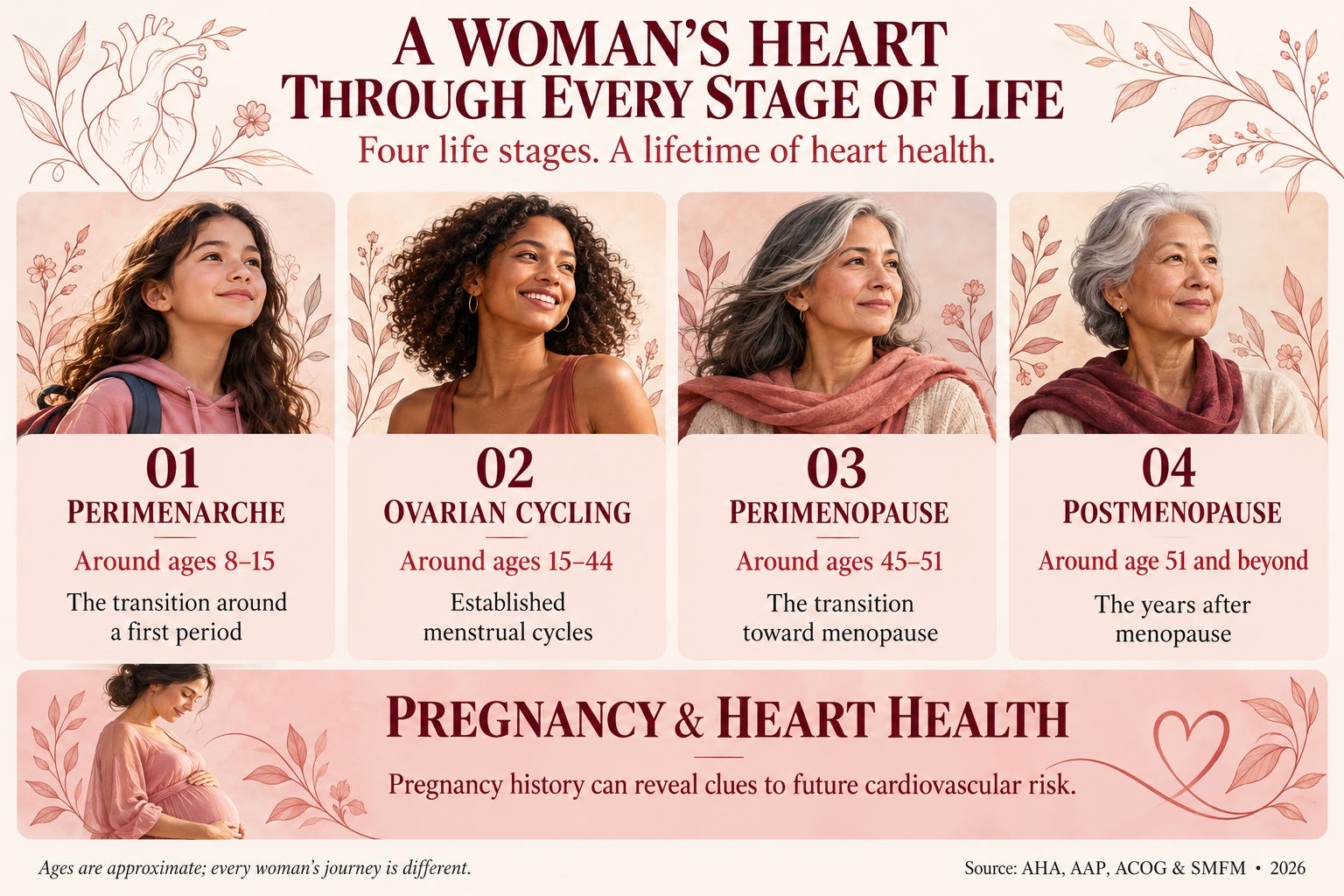
Stage 1: Perimenarche (about ages 8 to 15)
This is the time around a girl’s first period. Heart health starts here, long before adulthood [1]. Doctors are now being asked to treat menstrual cycles as a female-specific vital sign, like blood pressure or heart rate [1]. Heavy or irregular periods can be an early clue to heart risk, including a hormone condition now called PMOS (polyendocrine metabolic ovarian syndrome), the new name for what most of us know as PCOS [1]. The 2026 cholesterol guideline also recommends a cholesterol check for every child between ages 9 and 11 who hasn’t had one [6].
